


An all purpose cleaner is supposed to handle most surfaces in your home without requiring a separate bottle for every room. The problem is that most store-bought versions contain surfactants, synthetic fragrances, and preservatives that many households would rather not deal with — especially if you have children, pets, or anyone with sensitive skin.
The good news is that the most effective all purpose cleaners are also the simplest to make at home. Distilled white vinegar and water covers 90% of household surfaces. Castile soap covers most of the rest. (We know that sounds like something your grandmother would say. She was right. She usually was.)
Below is everything worth knowing: the two classic DIY formulas, what each ingredient actually does, which surfaces they're safe on, which surfaces they'll damage, and a newer option — HOCl-based cleaning — that we think is worth your attention if fragrance-free and non-toxic matters to you.
The short version
The simplest all purpose cleaner is equal parts distilled white vinegar and water. For marble, granite, cast iron, and waxed surfaces — where vinegar causes damage — use a diluted castile soap solution instead. Never mix the two. If you want fragrance-free, non-toxic, and safe for skin contact, HOCl tablets dissolved in water are worth considering: roughly $0.50 per 20 fl. oz. bottle, no fumes, 2-year tablet shelf life.
In this guide
- What actually makes a cleaner "all purpose"?
- The two recipes that handle most households
- What each ingredient actually does
- How to make your own in five steps
- The surfaces that can handle it — and the ones that can't
- There's a newer option worth knowing about
- What a bottle actually costs (all three options)
- Straight answers (FAQ)
What actually makes a cleaner "all purpose"?
Three things: it needs to break down grease and grime, suspend the mess so it can be wiped away, and do this without damaging the surface underneath. That's the whole job description.
Commercial formulas typically combine a surfactant (which breaks surface tension and lifts grime), an alkaline agent (which cuts grease), and something to extend shelf life. Some also include fragrance compounds and antimicrobial agents. The last two are largely cosmetic — most household surfaces don't need antimicrobial treatment. They need to be clean, which is different.
Homemade cleaners work for the same underlying reason: vinegar provides the mild acid that cuts mineral deposits and light grease, castile soap provides the surfactant that lifts grime, and baking soda provides gentle abrasion when you need it. Three ingredients. No chemistry degree required.
The honest opinion: most commercial all purpose cleaners are not significantly more effective than a good DIY version. What they offer is convenience, a longer ready-to-use shelf life, and a marketing budget that can afford the word "advanced." For most households, the $0.20 bottle you made in your kitchen does the same work.
The two recipes that handle most households
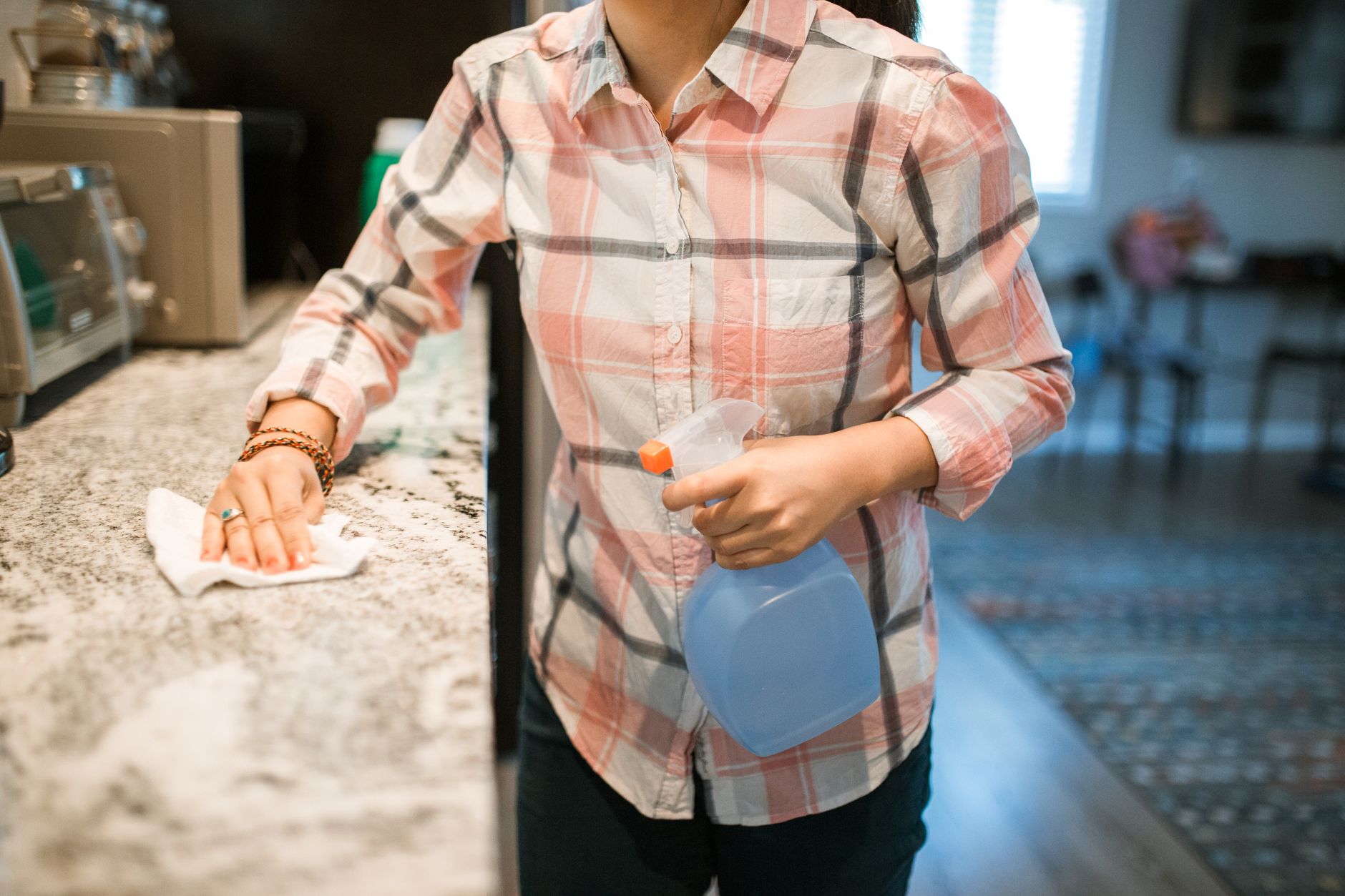
Two base formulas cover almost every surface in a standard home. Know which one to reach for and you're set.
Recipe 1: Vinegar-water spray (the default)
Fill a 16 fl. oz. spray bottle with equal parts distilled white vinegar and distilled water. Optional: add 10–15 drops of essential oil — lemon or tea tree are common — to mask the vinegar smell while it evaporates. The smell does evaporate. We checked.
Use this on: kitchen counters, stovetops, bathroom tile, ceramic, glass, mirrors, and stainless steel. It cuts through grease, light soap scum, and general grime without leaving residue.
Not safe for: marble, granite, natural stone, cast iron, hardwood floors, or wax-finished surfaces.
Vinegar is acidic. It etches stone permanently, strips cast iron seasoning, and can dull hardwood finishes over time. If any of these surfaces are in your home, keep a second bottle.
Recipe 2: Castile soap spray (for sensitive surfaces)
Add 1 teaspoon of fragrance-free liquid castile soap to 16 fl. oz. of distilled water. Shake gently before each use.
This is the better option for marble and granite countertops, sealed wood, and any surface where you'd rather avoid acid. It's also gentler on skin — useful if you're cleaning without gloves, or if a child touches a recently cleaned surface.
Do not mix vinegar and castile soap in the same bottle. The acid in vinegar reacts with the soap, neutralizing both. The fizzing looks satisfying. The result is mostly just water. Pick one base per bottle.
What each ingredient actually does

Understanding why each ingredient works means you can adapt when you're missing one — and avoid combining things that cancel each other out.
Distilled white vinegar
The 5% acetic acid content cuts through grease, mineral deposits, and soap scum. It evaporates cleanly without leaving residue. Cleaning vinegar (6–10% acetic acid) is stronger and better for stubborn buildup but more likely to damage acid-sensitive surfaces. For everyday use, regular white vinegar is fine.
Castile soap
A plant-based liquid soap — traditionally made from olive oil. It acts as a surfactant, reducing surface tension so grime lifts away rather than being pushed around. The fragrance-free versions are the better choice for households with skin sensitivities. The scented versions smell nice for about ten seconds, then your kitchen smells like a craft soap store — which is either appealing or alarming, depending on the household.
Baking soda
Sodium bicarbonate is a mild alkali. It doesn't work well in a spray bottle — it clumps and clogs the nozzle. It's most useful as a paste: mix a small amount with water or castile soap for scrubbing tile grout, sinks, and stovetops without scratching. See our guide on non-toxic oven cleaning for how it handles baked-on grease specifically.
Essential oils
Primarily there for scent. Tea tree oil is often cited for its properties, and there's published research supporting HOCl and other antimicrobial compounds — but 10 drops of tea tree oil in a 16 fl. oz. spray is a cosmetic quantity, not a meaningful one. Choose your cleaner base on what it does, not on what the oil's label claims.
Distilled water vs. tap water
Tap water with high mineral content leaves white streaks — especially on glass and mirrors. Distilled water eliminates this. If streak-free windows matter to you, it's worth the extra step.
How to make your own in five steps
-
Choose your base. Vinegar-water for most surfaces. Castile soap for natural stone, wood, and anywhere acid can cause damage.
-
Measure the formula. Vinegar-water: equal parts (1:1) distilled white vinegar and distilled water. Castile soap: 1 teaspoon of liquid castile soap per 16 fl. oz. of distilled water.
-
Add optional fragrance. If you want a scent, add 10–15 drops of essential oil. Lemon and orange help with grease. Lavender and tea tree are popular for bathrooms.
-
Pour into a clean spray bottle. Label it clearly — including the formula and the date you made it. Future-you will appreciate this.
-
Shake before each use. Especially the castile soap version, which can separate slightly over time.
Shelf life: vinegar-water spray keeps indefinitely — white vinegar doesn't spoil. The castile soap version stays effective for several months. Store both in a cool, dark place away from direct sunlight.
The surfaces that can handle it — and the ones that can't
This is the section most DIY cleaning guides get wrong by omission. Surface compatibility is where the decisions that feel fine in the moment turn expensive in six months.
Safe for vinegar-water spray
- Ceramic and porcelain tile
- Glass and mirrors
- Stainless steel (appliances, sinks)
- Laminate countertops
- Stovetops (not cast iron)
- Bathroom tile, grout, and fixtures
- Vinyl and linoleum floors
Not safe for vinegar-water spray
- Marble, granite, and natural stone — acetic acid etches the surface permanently, leaving dull spots that require professional polishing to fix. Use pH-neutral castile soap instead.
- Cast iron pans and skillets — vinegar strips the seasoning you've spent months building. Clean cast iron with hot water and a stiff brush only.
- Hardwood floors — undiluted vinegar can dull the finish over time. If you use it on wood, dilute heavily and minimize moisture contact.
- Wax-finished surfaces — vinegar strips wax. Furniture and countertops with a wax finish should be cleaned with castile soap only.
- Screens and electronics — any liquid risks damage. A dry or barely damp microfiber cloth is the right tool here.
Worth printing this list and keeping it in the cleaning cabinet. That is not a joke. It is also slightly the kind of thing that makes other people in the household raise an eyebrow, which we accept as the cost of doing business.
There's a newer option worth knowing about
Vinegar and castile soap have been doing this job for generations. They're cheap, effective, and low-waste. We're not going to argue against either of them.
But there's a third option that's worth knowing about — particularly if you have children, pets, or household members with reactive skin who'd rather not clean with vinegar fumes or fragranced products.
Hypochlorous acid (HOCl) is a compound your body actually produces naturally. When stabilized and dissolved in water at the right concentration, it creates a non-toxic, fragrance-free, pH-balanced surface cleaner. No fumes. No synthetic surfactants. No residue. Safe for skin contact if someone touches a recently cleaned surface.
The catch with pre-made HOCl spray bottles is that the compound breaks down over time — most have a usable shelf life of 3 to 6 months. The tablet format solves this: the tablets keep for up to 2 years. You dissolve one in water when you need it, and you have a fresh solution every time. It also happens to be an effective household cleaner in its own right — worth understanding if you're already using it on skin.
GentleSen Family Tab Kit
HOCl tablets — dissolve in water for a fresh batch anytime
- ~$0.50 per 20 fl. oz. bottle
- Fragrance-free, non-toxic, no harsh fumes
- pH-balanced — gentle enough for skin contact
- Safe around kids and pets
- Tablet shelf life: up to 2 years
- No shipping water — lighter, less plastic
Where HOCl fits in the lineup: it works on most of the same surfaces as vinegar-water, without the acid risk to stone or cast iron, and without the fragrance. If you're already using GentleSen for skincare, the same tablet makes your surface cleaner. One product, two uses.
What a bottle actually costs (all three options)
One thing the top DIY cleaning guides almost never cover: actual cost per bottle. Here's the honest comparison.
| Option | Cost per 16–20 fl. oz. bottle | Shelf life (ready to use) |
|---|---|---|
| Vinegar-water (homemade) | $0.10–$0.20 | Indefinite |
| Castile soap spray (homemade) | $0.25–$0.40 | Several months |
| GentleSen HOCl tablets | ~$0.50 | 1 week mixed (tablet: 2 years) |
| Name-brand commercial cleaner | $3–$6 | 1–2 years |
Homemade wins on cost. The commercial cleaner wins on ready-to-use shelf life. HOCl tablets sit in the middle — more expensive than vinegar-water, significantly cheaper than store-bought, and the better choice if fragrance-free and non-toxic are priorities. Worth noting: the $3–$6 commercial bottle includes the cost of shipping water across the country, which is neither cheap nor necessary.
Straight answers (FAQ)
Can I use an all purpose cleaner on marble or granite?
Not if it's vinegar-based. Vinegar is acidic and etches natural stone over time, leaving dull spots that require professional polishing to reverse. Use a pH-neutral cleaner on marble, granite, and quartz — a diluted castile soap solution or a dedicated stone cleaner are both safe options.
Does vinegar really clean as well as commercial cleaners?
For most household surfaces, yes. The 5% acetic acid in distilled white vinegar cuts through grease, mineral deposits, and general grime effectively. Where vinegar falls short: stone and acid-sensitive surfaces, and stubborn buildup that a stronger formula handles better. For everyday counters, tile, and glass, there's no meaningful gap in cleaning performance.
Can I mix vinegar and baking soda in a spray bottle?
Technically yes — practically, no. When an acid (vinegar) meets a base (baking soda), they neutralize each other. The fizzing looks satisfying but produces mostly water and carbon dioxide. You're left with a solution that doesn't clean particularly well. Use them separately: vinegar spray for surfaces, baking soda paste for scrubbing.
What's the best all purpose cleaner for homes with kids and pets?
Any fragrance-free, low-chemical formula. Diluted castile soap is a solid choice — plant-based and gentle. HOCl-based solutions are also worth considering: non-toxic, no synthetic fragrances, and pH-balanced enough for skin contact if a child touches a freshly cleaned surface. Avoid formulas with strong synthetic fragrances, ammonia, or chlorine bleach around either group.
How long does a homemade all purpose cleaner last?
Vinegar-water spray: essentially indefinite — white vinegar doesn't spoil. Castile soap spray: 2–3 months before the soap can start to degrade. HOCl solution: 1–2 weeks after mixing (the compound breaks down over time, particularly with light exposure), though the unmixed tablets keep for up to 2 years.
Can I add essential oils to a vinegar cleaner?
Yes. 10–15 drops per 16 fl. oz. is standard. Tea tree and citrus oils are common choices. At this quantity, they're primarily cosmetic — they make the cleaner smell better while the vinegar does the cleaning work. The essential oil itself isn't contributing meaningfully to cleaning performance at that concentration.
Is white vinegar the same as cleaning vinegar?
No. Regular white vinegar is typically 5% acetic acid. Cleaning vinegar runs 6–10%. The stronger version is better for tackling mineral buildup and stubborn stains — but because it's more acidic, it's also more likely to damage sensitive surfaces and should be kept away from skin contact. For everyday cleaning, regular white vinegar is sufficient.
What's the difference between all purpose cleaner and multi purpose cleaner?
Nothing meaningful. The terms are used interchangeably across brands and recipes. Some products use "multi purpose" to suggest broader application, but there's no industry standard separating the two. If a recipe calls for either, the same formula applies.
The right cleaner is the one that suits your home
For most households, two bottles cover everything: a vinegar-water spray for daily use, and a castile soap solution for stone countertops, wood, and cast iron. Make a batch of each, label them, and you're done.
If fragrance-free and non-toxic is the priority — or if you're already using HOCl for skincare and want one product that pulls double duty — GentleSen tablets dissolve in water and handle the rest. Roughly $0.50 a bottle. No fumes. No residue. No explanation required to anyone in the household about why your kitchen smells like a salad dressing.
Sources and further reading
- EPA Safer Choice Program — criteria for safer cleaning product ingredients
- Environmental Working Group: Guide to Healthy Cleaning — ingredient safety ratings for household cleaners
- U.S. National Library of Medicine (PubMed) — peer-reviewed research on HOCl and acetic acid in cleaning applications
This post is for informational purposes only and is not medical or professional cleaning advice. GentleSen is a multi-purpose cleaner and is not a medical device. Always read product labels and follow safe handling guidelines for any cleaning product. Consult a professional for surfaces with specific care requirements.
0 comments