


How to clean a dishwasher, our way: drop one to two Gentle Sen HOCl tablets straight into the empty detergent dispenser and run a hot cleaning cycle with no dishes inside. That's the whole method for the tub. Follow it with a quick spray-and-wipe of the door seal and drain using a diluted tablet solution, and you're done — no measuring vinegar, no second cycle, no separate baking soda step.
We get why this feels backwards — the appliance whose entire job is "get things clean" needing its own cleaning is a little like your toothbrush needing a toothbrush. But food scraps, hard water minerals, and grease don't disappear just because they went through a wash cycle. They settle into the filter, the seal, and the drain, and they sit there until someone deals with them directly. Below is our recommended tablet method, the classic vinegar-and-baking-soda routine if you'd rather use what's already in the pantry, why the smell has a habit of coming back, and when it stops being a cleaning problem at all.
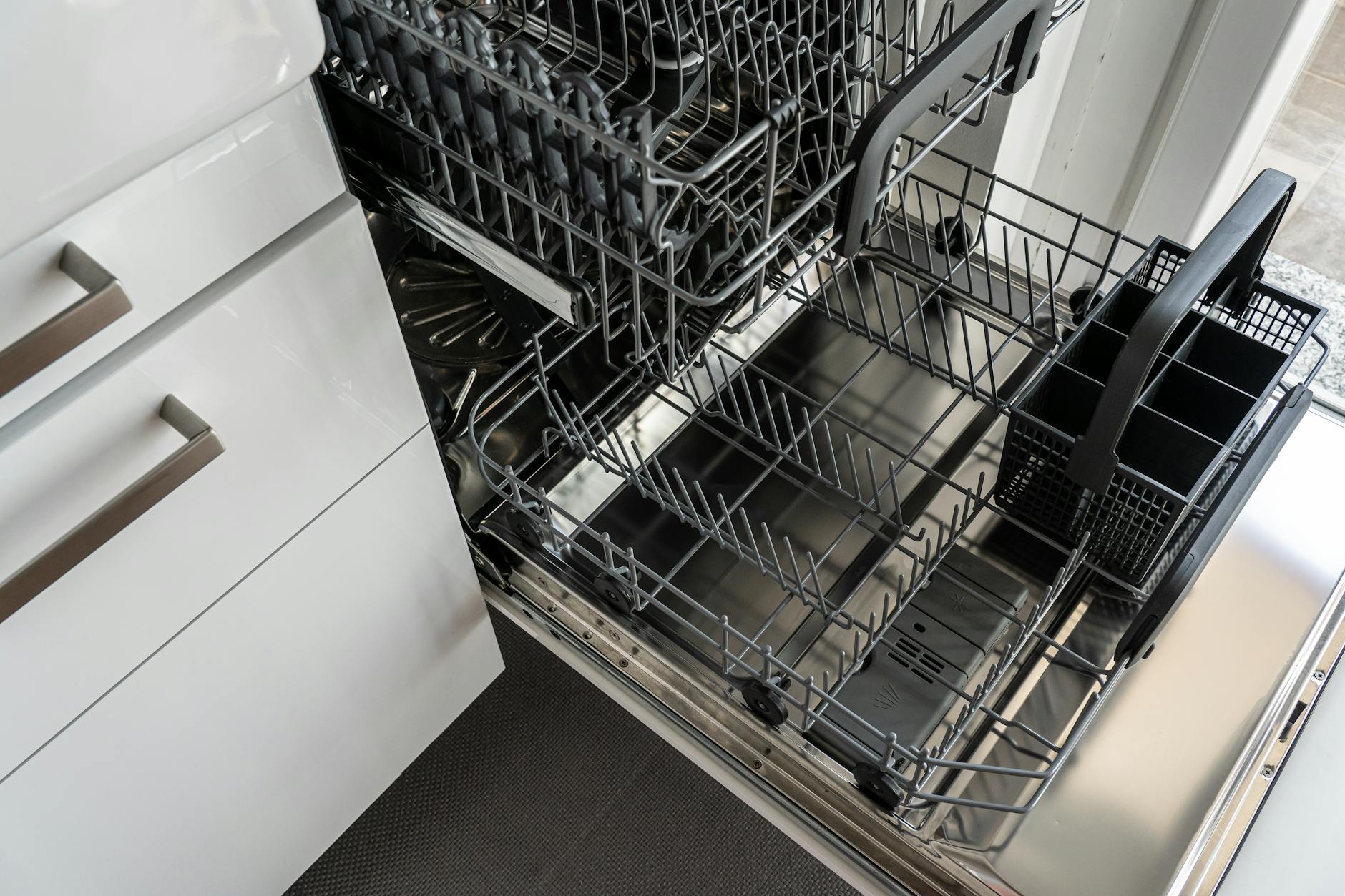
The short version
Our recommended method: drop one to two Gentle Sen HOCl tablets into the empty detergent dispenser and run a hot cleaning cycle with no dishes inside — the whole tub done in one pass. For the door seal, spray arm holes, and drain, dissolve one tablet in 20 fl. oz. of lukewarm water, spray it on, let it sit a minute or two, and wipe — no rinse needed. No tablets on hand? Run an empty hot cycle with two cups of white vinegar, then a second cycle with a cup of baking soda, and wipe the seal by hand instead — just never combine either method with bleach. Pull and rinse the filter every one to two weeks regardless of which method you use. If dishes are still cloudy or the smell won't quit after all that, it's usually not a cleaning problem anymore.
In this article
- How often you actually need to do this
- Start with the filter (it fixes most of it)
- Our recommended method: Gentle Sen HOCl tablets
- No tablets on hand? Vinegar, then baking soda
- The door seal, spray arms, and drain
- Why it smells again a week later
- When it's not a cleaning problem
- Frequently asked questions
How Often You Actually Need to Do This
Every wash cycle leaves something behind. Food particles too small for the filter to fully catch, hard water minerals, and grease from anything you didn't scrape well enough settle into the filter basket, the door seal, and the drain trap — the parts a normal cycle rinses around, not through.
For a typical household running one load a day, pull and rinse the filter every one to two weeks and run a full deep clean — our tablet method or the vinegar-and-baking-soda alternative — once a month. If you're in hard water territory or running the dishwasher daily, cut both intervals in half.
Here's the part that surprises people: a filter that's gone unchecked for a month isn't just dirty, it's actively working against you — a mesh basket that's more debris than mesh starts letting particles pass straight back onto your "clean" dishes. If your glasses have come out cloudy or gritty lately, that's usually the answer before you've even opened the door.
Start With the Filter (It Fixes Most of It)
If you only do one thing on this list, do this. The filter sits at the bottom of the tub, usually under the lower spray arm, and it's built to come out by hand — no tools required.
-
1
Twist and lift. Most filters have a cylindrical piece that turns a quarter turn and lifts straight out, sometimes with a flat mesh screen sitting underneath it.
-
2
Rinse under hot running water, working a soft brush — an old toothbrush is fine — into the mesh to knock loose anything caked on.
-
3
Check the sump underneath — the open well the filter sat in — for glass shards, bones, produce stickers, and anything else that made it past the pre-rinse.
-
4
Reseat and lock it back in. A filter that isn't clicked into place properly rattles during the cycle and stops filtering anything at all.
(A produce sticker in the sump is basically a rite of passage. We don't know why it's always a produce sticker. We just know it always is.)
We've written a longer dishwasher filter cleaning guide if yours is more stubborn than a quick rinse can handle.
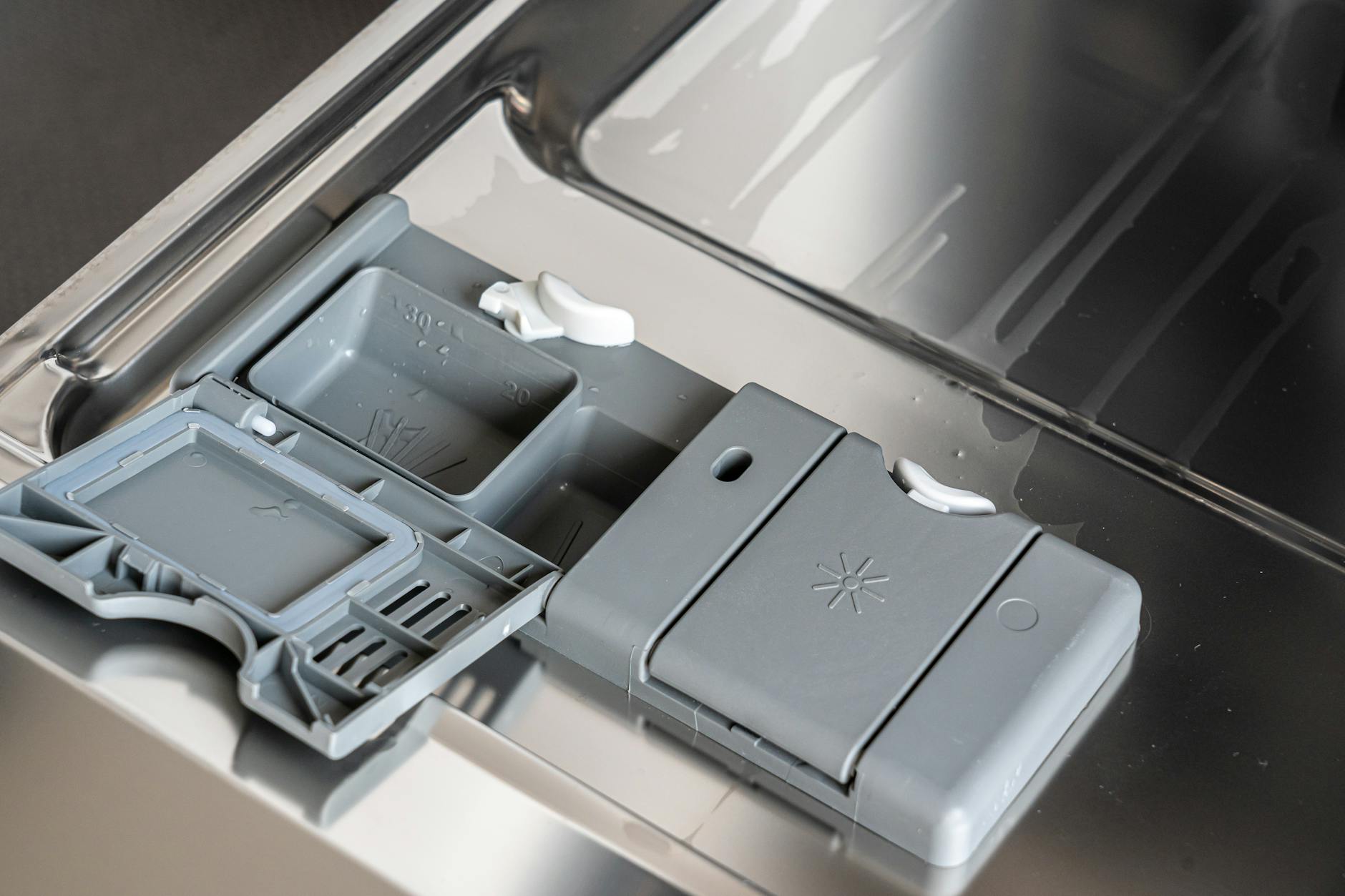
Our Recommended Method: Gentle Sen HOCl Tablets
This is the method we use ourselves, and it's the one we'd hand a friend first. One tablet in the dispenser replaces two ingredients and two cycles.
-
1
Empty the dishwasher completely. No dishes, no cutlery basket contents — just the machine itself.
-
2
Place one to two Gentle Sen HOCl tablets directly in the detergent dispenser — the same spot your regular detergent pod goes.
-
3
Run a hot cleaning cycle (your dishwasher's dedicated "clean" or "extra-hot rinse" setting if it has one, otherwise the hottest normal cycle).
-
4
While that runs, dissolve one tablet in 20 fl. oz. of lukewarm water in a spray bottle — our standard Pro Strength ratio for general surfaces.
-
5
Once the cycle finishes, spray the door seal, gasket folds, and the visible part of the drain, let it sit for a minute or two, and wipe with a cloth. No rinse needed.
Why we default to this:
One tablet in the dispenser replaces measuring vinegar into a bowl, running a second cycle for baking soda, and hunting down a separate spray for the seal. Gentle Sen tablets are fragrance-free and non-toxic, so there's no chemical smell competing with a kitchen that shares air with the rest of the house — and the dissolved solution works out to about $0.50 per 20 fl. oz., without the shipping weight of a pre-mixed spray bottle.
We use the same tablets around the rest of the kitchen too — see our full list of ways to use Gentle Sen tablets for dilution ratios on everything from coffee makers to produce washing.

Never combine bleach with vinegar, baking soda, or a Gentle Sen tablet cycle, whether in the same cycle or back to back without a full rinse between them. Mixing bleach with an acidic or oxidizing cleaner can release chlorine gas, and a closed dishwasher is not where you want that happening. If your model's manual specifically calls for bleach, run it as its own standalone cycle only.
No Tablets on Hand? Vinegar, Then Baking Soda
If you'd rather use what's already in the pantry, the classic method still works — it's just two ingredients and two cycles instead of one tablet and one.
-
1
Empty the dishwasher completely. No dishes, no cutlery basket contents — just the machine itself.
-
2
Place two cups of white vinegar in a dishwasher-safe bowl on the top rack, upright so it doesn't tip during the wash.
-
3
Run the hottest cycle available, with the heat-dry option off. The vinegar mixes into the wash water and cuts through grease film and mineral scale as it circulates.
-
4
Once that cycle finishes, sprinkle a cup of baking soda across the bottom of the empty tub and run a second, shorter hot cycle.
-
5
Wipe the interior walls and door with a clean cloth once it's done. You're mopping up what both cycles loosened before it has a chance to resettle.
The Door Seal, Spray Arms, and Drain
Either method above cleans the tub. Neither one cleans these three spots on its own, which is exactly why a dishwasher can look spotless and still smell off.
Door seal. Run a finger along the rubber gasket that lines the door — it traps water and food splatter after every wash. Wipe it dry with a cloth (dampened with leftover Gentle Sen solution if you mixed some for the step above, since a five-second wipe beats digging out a separate cleaner) and check the folds for any dark spotting.
Spray arms. Pull the upper and lower arms out (most just lift off) and hold them up to the light. If any of the small jet holes look blocked, clear them with a toothpick, not a metal pin, which can widen the hole and throw off the spray pattern.
Drain. At the very bottom, under where the filter sat, there's usually a small grate over the drain opening. Clear any visible debris by hand, then let whichever cleaning cycle you ran above do the rest.
Why It Smells Again a Week Later
A dishwasher that smells right after a deep clean and doesn't a week later isn't a sign you did it wrong. Researchers who sampled the rubber door seals of household dishwashers have consistently found a biofilm living there — a thin, damp layer that hosts a mix of bacteria and fungi, including species that can survive the heat, detergent, and salt a normal cycle throws at it. That's not a defect in your machine. It's just what happens when a warm, occasionally wet surface sits closed up between uses.
The seal and the drain area are where this biofilm tends to settle in hardest, since they stay damp the longest after a cycle ends. A tablet cycle or a vinegar-and-baking-soda cycle both knock it back, but neither sterilizes the machine permanently — nothing does, short of leaving the door open between loads so the seal actually dries.
That's the real fix behind the "wipe the seal, crack the door" advice you'll see everywhere: it's not about aesthetics, it's about not giving that film the damp environment it needs to regroup. It's also why we build the seal spray into our own method above rather than treating it as optional.
When It's Not a Cleaning Problem
We'd rather tell you this now than have you run a fourth cycle for nothing. A clean, well-maintained dishwasher that still won't dry dishes, still leaves standing water, or makes a grinding noise on drain isn't asking for another cleaning cycle — it's asking for a repair tech.
Signs it's mechanical, not dirt: standing water that doesn't clear even right after a cleaning cycle, a drain pump that hums but doesn't actually pump, a float switch that's stuck (the small dome near the front that senses water level), or a heating element that's stopped kicking on for the dry cycle. None of those improve with more tablets or more vinegar.
If the filter is clean, the seal is dry, and dishes are still coming out wet, cloudy, or gritty, that's your cue to call someone rather than run another cleaning cycle.
One Tablet, Fifteen Minutes, Not a Saturday Project
Cleaning a dishwasher sounds like a bigger job than it is — especially when one tablet in the dispenser does what vinegar, baking soda, and a separate seal spray used to take three steps to do. Rinse the filter, run one cycle, spray and wipe the seal — about the time it takes to unload the dishes it just washed.
Skip it for six months and it's not one bigger clean later — it's the same clean, against a machine that's had longer to build the habit you now have to break.
Shop the Gentle Sen HOCl Tablet Kits →Frequently Asked Questions
How often should I clean my dishwasher?
Rinse the filter every one to two weeks and run a full deep clean — tablet or vinegar-and-baking-soda — once a month for a typical household. If you have hard water or run the dishwasher daily, cut both intervals in half. A visible smell or cloudy dishes mean it's time now, not on the next scheduled date.
How do I clean my dishwasher with Gentle Sen HOCl tablets?
Place one to two tablets directly in the detergent dispenser — the same spot your regular detergent goes — and run a hot cleaning cycle with no dishes inside. For the door seal and drain, dissolve one tablet in 20 fl. oz. of lukewarm water, spray it on, let it sit a minute or two, and wipe. No rinse needed.
Why does my dishwasher smell even after I clean it?
The door seal and drain area develop their own biofilm — a thin, damp layer that bacteria and fungi settle into between uses, even in a machine that's otherwise clean. A tablet cycle or vinegar and baking soda knock it back but don't remove it permanently. Wiping the seal dry and leaving the door cracked between loads is what keeps it from regrouping as fast.
Can I use bleach to clean my dishwasher?
Only as its own standalone cycle, if your manufacturer's manual specifically allows it, and only if the interior isn't stainless steel, which bleach can discolor. Never combine bleach with vinegar, baking soda, or a tablet cycle in the same or a back-to-back run — that combination can release chlorine gas. We default to a tablet cycle or vinegar and baking soda for that reason.
Are Gentle Sen tablets safe to use with my regular dishwasher detergent?
Run them as separate cycles rather than combining them. Use the tablet cycle empty, with no dishes, for the monthly deep clean — then run your regular detergent normally for actual dishwashing loads. Mixing them into the same load doesn't damage anything, it just dilutes the tablet cycle and defeats the point of running it empty.
How do I clean a dishwasher filter?
Twist and lift the cylindrical filter piece out from the bottom of the tub, rinse it under hot water while scrubbing the mesh with a soft brush, check the open sump underneath for stray debris, then click the filter back into place. It should take under five minutes once you know where it sits.
Why is there standing water in the bottom of my dishwasher?
A small amount left in the sump after a cycle is normal — it keeps the pump seal from drying out. A puddle that doesn't drain at all, or gets deeper over time, usually means the drain area is clogged with debris or the drain pump itself is failing. Clear the drain and filter first; if water still won't clear, that's a repair call.
Why are my dishes still cloudy or gritty after washing?
Cloudiness is usually hard water mineral film, which a deep-clean cycle clears. Grit is almost always a dirty or improperly reseated filter letting food particles recirculate instead of draining away. Check and rinse the filter first — it resolves the gritty-dish complaint more often than any other single fix.
Sources
- Synergistic Interactions in Microbial Biofilms in Household Dishwashers — National Institutes of Health (PMC)
- Microbial Diversity in Dishwasher Biofilm Communities — National Institutes of Health (PMC)
- Dishwashers — U.S. Department of Energy
This article is for informational purposes only and does not constitute professional appliance-repair advice. Gentle Sen products are general-purpose cleaners and are not intended to diagnose, treat, or prevent any condition.
0 comments