


Glass cleaner is one of the simplest things in the cleaning aisle — until you read the label. Most conventional formulas work, but they tend to involve ammonia (which clears the room), synthetic fragrances, and instructions to ventilate that realistically nobody follows when cleaning a bathroom mirror at 7am. Paper towels handle the wiping. They also leave lint on every pane. This is their greatest betrayal, and we haven't fully forgiven them.
Non-toxic glass cleaners are a reasonable switch — and for households with kids, pets, birds, or anyone with asthma or skin sensitivities, a genuinely worthwhile one. The catch is that the solution is only half the answer. Most streaks come not from the cleaner but from what you wipe with.
Here's what actually works: why conventional formulas use what they use, the two real causes of streaks, non-toxic DIY recipes, and a complete system that makes streak-free glass easy to maintain.
The short version
Most glass streaks come from minerals in tap water and lint from paper towels — not the cleaner itself. Switch to distilled water in your solution and a lint-free cloth, and streaks largely disappear. For a non-toxic formula, a 1:1 mix of white vinegar and distilled water works well. HOCl solution (from a Gentle Sen tablet) is a fragrance-free, pH-balanced alternative with no vinegar smell. The right cloth — like the Gentle Cloth — finishes the job without lint or residue.
In this guide
What's actually in conventional glass cleaners
The two main active ingredients in most commercial glass cleaners are ammonia and isopropanol. Both are effective — they cut through grease, evaporate quickly, and leave glass looking clean. Both are also respiratory irritants in enclosed spaces, which is why the label says to ventilate. In a large, open room, this is a minor concern. In a small bathroom with the door closed, it's a more relevant one.
Ammonia is worth a specific mention for bird owners. The fumes are acutely toxic to pet birds even at concentrations that feel mild to humans. Parakeets, cockatiels, and other birds have highly efficient respiratory systems — which is efficient until it isn't. If you have birds in the house, ammonia-based glass cleaners are worth switching away from regardless of other considerations.
Synthetic fragrances are the third ingredient most people don't think about. They're not doing the cleaning — they're making "clean" smell a particular way. For households with fragrance sensitivities, eczema, or asthma, they're an unnecessary variable.
None of this makes conventional glass cleaners dangerous in normal outdoor or well-ventilated use. It just means the ingredients aren't mandatory. You can clean glass just as well — streak-free, residue-free — without them.
The two real causes of streaks (and why the cloth is half the answer)
Most people blame the cleaner when glass streaks. Usually, it's not the cleaner.
Cause 1: Minerals in tap water. Hard water contains calcium and magnesium. When your cleaning solution dries, those minerals stay behind as a white haze or faint smear. Mixing your cleaner with distilled water instead of tap water eliminates this almost entirely. It's the single biggest upgrade most people skip.
Cause 2: The cloth. Paper towels shed lint. Cotton rags smear moisture rather than absorbing it. Neither produces a clean, dry finish on glass. A lint-free reusable cloth picks up solution and grime without depositing fibers, leaving the surface genuinely clear.
There is a school of thought that recommends using newspaper to clean glass. The people who advocate for this are the same ones who still have a functioning newspaper subscription. We respect them deeply. For everyone else, a good reusable cloth does the same job, doesn't transfer ink to the glass, and works indefinitely.
Timing is the third factor. Cleaning glass in direct sunlight means your solution evaporates in seconds, leaving residue before you've wiped. Clean in the morning before the sun hits the pane, or wait for an overcast window.

Non-toxic glass cleaner recipes that actually work
Two formulas are worth knowing. Both work. They have different trade-offs.
Option 1: White vinegar + distilled water
Mix equal parts distilled white vinegar and distilled water in a spray bottle. This is the classic DIY formula, and it performs well on standard glass surfaces. The acidity cuts through grease and mineral deposits cleanly. Cost per bottle: well under a dollar.
The vinegar smell goes away once it dries. It just takes a few minutes, during which the kitchen smells vaguely like a chip shop that's lost its way. For most households, this is a minor annoyance. For households with strong fragrance sensitivities, it's worth noting.
One firm limitation: don't use vinegar on natural stone surfaces — marble, granite, travertine, or stone composites. The acid etches the surface over time. Stick to glass, mirrors, and stainless steel.
Option 2: HOCl solution (no smell, pH-neutral)
Hypochlorous acid (HOCl) solution is the fragrance-free alternative. It's pH-balanced, non-toxic, odorless, and leaves no residue on glass when mixed with distilled water. A Gentle Sen HOCl tablet dissolved in 20 fl. oz. of distilled water costs about $0.50 per bottle. It works on glass, mirrors, and most household surfaces, and it's safe around kids, pets, and sensitive-skin households.
Unlike vinegar, HOCl is pH-neutral, so it doesn't carry the same risk on surfaces where acidity is a concern. It won't etch grout, stone, or specialty coatings. The solution stays effective for about 7 days after dissolving — make it fresh each week or as needed.
For both formulas, the rule is the same: distilled water in the mix, lint-free cloth for the wipe. That combination does more for streak-free results than the choice of cleaner.

The Gentle Sen system: HOCl solution + Gentle Cloth
The reason glass cleaning often disappoints is that most people optimize one half and ignore the other. A good solution paired with paper towels still leaves lint. A great cloth paired with tap water still leaves mineral residue. The right combination is both.
The Gentle Cloth is made from material imported from Germany — 100% compostable, machine washable, and lint-free on glass. One cloth replaces up to 1,500 paper towels. It air-dries quickly, which matters: you want a dry cloth for the final buffing pass, not a damp one that smears. The construction leaves no fibers on glass or mirrors.
Pair it with an HOCl solution from the Gentle Sen Family Tab Kit and distilled water, and you have a complete, fragrance-free glass cleaning system for around $0.50 per bottle — no ammonia, no vinegar smell, no plastic waste from disposable paper towels.
Gentle Cloth — 5-Pack
100% compostable, streak-free on glass and mirrors. Material imported from Germany. Replaces up to 1,500 paper towels per cloth. Machine washable, air-dries fast, leaves no lint. 5 stars across all reviews.
$19.00
Get the Gentle Cloth →Gentle Sen Family Tab Kit
100 HOCl tablets, a 20 fl. oz. refillable mist bottle, a 3.4 fl. oz. travel bottle, and a tablet splitter. Fragrance-free, pH-balanced, non-toxic. About $0.50 per 20 fl. oz. bottle — no ammonia, no vinegar smell, 2-year dry shelf life. Replaces $200+ in annual cleaning spray costs.
See the Tab Kit →How to use it — step by step
-
1
Make your solution. Dissolve one Gentle Sen tablet in 20 fl. oz. of distilled water (or mix equal parts white vinegar and distilled water). Pour into a spray bottle.
-
2
Choose your timing. Morning or overcast days are ideal. Direct sunlight makes the solution evaporate before you wipe, leaving residue that's harder to shift than what you started with.
-
3
Spray lightly and evenly. A thin, even coat is enough. Soaking the glass just means more wiping. Two or three passes across the surface is sufficient.
-
4
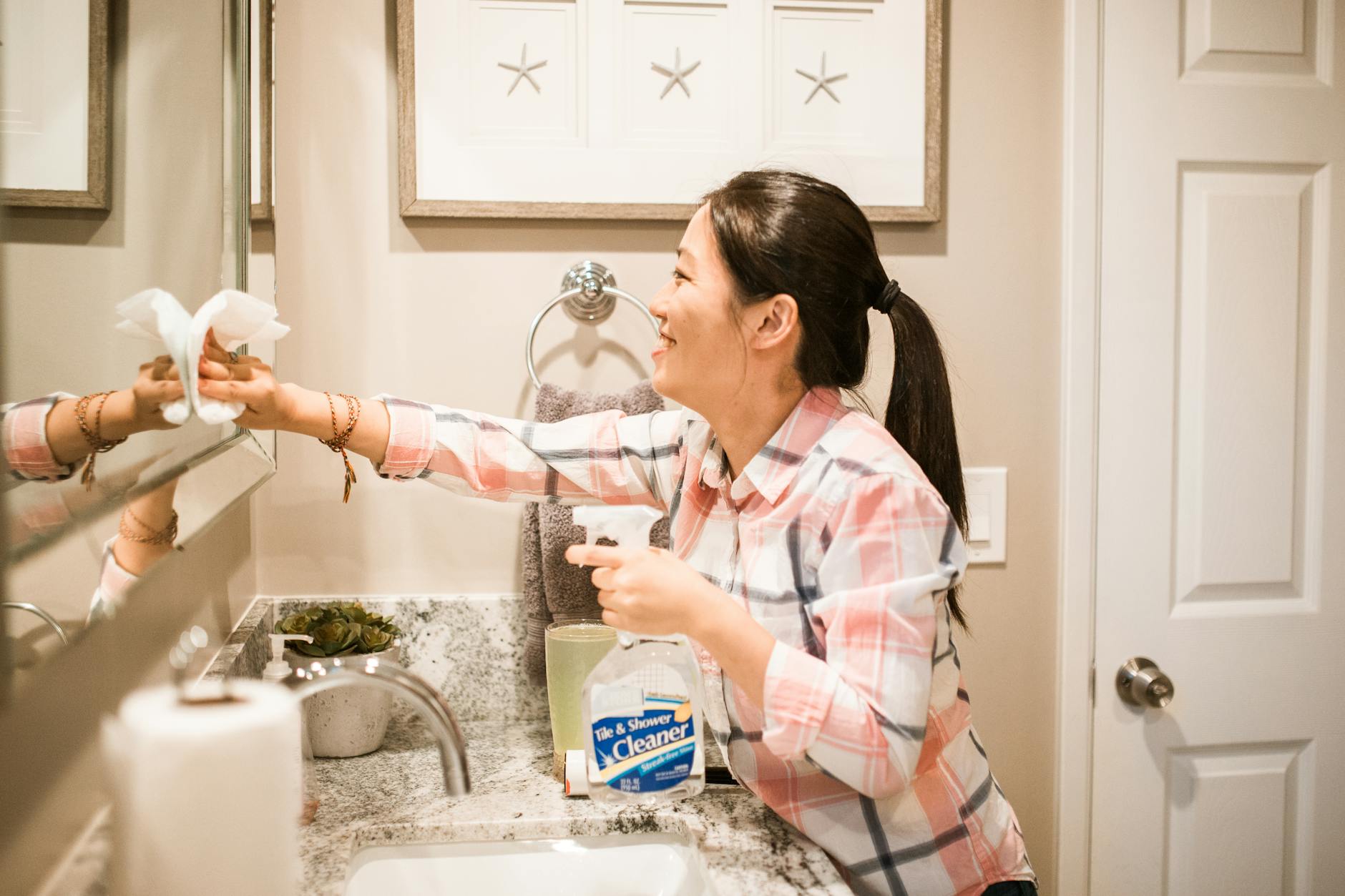
Wipe with the damp side of the Gentle Cloth. Work in a circular or Z-pattern to lift grime before the solution dries. Don't scrub — the cloth does the work.
-
5
Buff with the dry side. Flip the cloth and make one final pass in straight vertical or horizontal strokes. This removes any remaining moisture and delivers the streak-free finish.
What you can (and cannot) clean this way
This approach works well on most glass surfaces in a standard home:
- Interior windows
- Mirrors — bathroom, bedroom, entryway
- Glass tabletops and shelving
- Glass shower screens and enclosures
- Glass oven doors (cold only — never spray glass that's still hot)
- Glass splashbacks
- Glass picture frames and display cases
Self-cleaning glass: Some modern double-glazed windows have a self-cleaning coating that works through UV light and rain. Any spray cleaner can degrade this coating over time. If you're not sure whether your windows are self-cleaning, check the manufacturer specs before spraying anything on them — including non-toxic formulas.
After-market tinted windows: Tint films vary in their tolerance for cleaning agents. Check with your installer before using any spray on tinted glass. In most cases, plain water and a soft cloth is what they recommend.
If you're using the vinegar formula: Don't use it on marble, granite, travertine, or any natural stone surface. The acid etches the material over time. HOCl is pH-neutral and doesn't carry this risk.
Straight answers (FAQ)
What is the best non-toxic glass cleaner?
A 1:1 mix of distilled white vinegar and distilled water is the most common DIY option, and it works well on most glass. For a fragrance-free alternative with no vinegar smell, an HOCl solution (from a Gentle Sen tablet dissolved in distilled water) is pH-balanced, non-toxic, and leaves no residue. Whichever formula you use, pair it with a lint-free cloth — that's where most of the streak-free result actually comes from.
Why does my glass cleaner leave streaks?
Almost always one of two things: minerals in tap water, or the cloth. Hard water leaves calcium and magnesium deposits on glass when the solution dries. Paper towels and cotton rags leave lint or smear moisture instead of removing it. Switching to distilled water in your cleaning solution and a lint-free reusable cloth fixes the majority of streak problems — regardless of which cleaner you use.
Is vinegar safe to use on all types of glass?
Vinegar is safe on standard glass, mirrors, and stainless steel. It is not safe on natural stone — marble, granite, travertine — where the acidity etches the surface over time. It's also worth avoiding on some specialty coatings like anti-reflective glass. For those surfaces, a pH-neutral solution like HOCl or plain distilled water is the better choice.
Is HOCl solution safe on glass and mirrors?
Yes. HOCl is pH-neutral, non-toxic, and leaves no residue on glass when mixed with distilled water. It's safe around children, pets, and sensitive-skin households. Once dissolved, the solution stays effective for about 7 days. It's also odorless — no vinegar smell, no ammonia smell, no added fragrance.
What is the best cloth for cleaning glass without streaks?
A lint-free, reusable cloth designed for glass. Paper towels leave fibers. Cotton cloths smear. The Gentle Cloth is 100% compostable, lint-free on glass and mirrors, and machine washable. The technique matters too: use the damp side to clean, then flip to the dry side for a final buff. That two-step approach is what produces a genuinely streak-free result.
How often should you clean glass windows?
Interior glass — mirrors, glass tabletops, interior windows — as needed, roughly every one to two weeks in regularly used areas. Exterior windows depend on your environment: most homes benefit from cleaning two to four times per year. If you're near a busy road, construction, or the coast, more frequently makes sense. Dust, traffic film, and salt spray build up faster than you'd expect.
Is ammonia in glass cleaners harmful?
For most adults using them in ventilated spaces, conventional ammonia-based glass cleaners are not acutely dangerous. The exceptions: ammonia fumes are toxic to pet birds even at concentrations that feel mild to humans; and for people with asthma, respiratory sensitivities, or young children, the fumes in small enclosed spaces are worth avoiding. Non-toxic alternatives do the same cleaning job without this concern.
Can the Gentle Cloth be used on surfaces other than glass?
Yes. The Gentle Cloth works on countertops, appliances, bathrooms, and most household surfaces. Its lint-free, streak-free performance is most noticeable on glass and mirrors, but it's designed as a general-purpose replacement for paper towels across the board. Each cloth replaces up to 1,500 paper towels and is machine washable.
The bottom line on glass cleaner
Most people who get streaky glass are using the right formula with the wrong cloth, or the right cloth with tap water. Fixing those two things — distilled water in your mix, lint-free cloth for the wipe — does more for streak-free results than any product upgrade.
For households that want to skip ammonia, fragrances, and disposable paper towels entirely, the Gentle Sen + Gentle Cloth combination covers both sides of the equation: a non-toxic, odorless cleaning solution and a compostable cloth that won't leave a fiber behind.
Your windows have been trying to be transparent this whole time. The paper towel lint was getting in the way.
Try the Gentle Cloth →Sources
- U.S. EPA Safer Choice Program — evaluating cleaning product ingredients for safety and environmental impact
- National Institutes of Health — The Antimicrobial Efficacy of Hypochlorous Acid (NLM/NIH, 2020)
- Environmental Working Group — Guide to Healthy Cleaning
This article is for informational purposes only. Gentle Sen HOCl tablets are a multi-purpose household cleaner. They are not intended to diagnose, treat, cure, or prevent any disease or medical condition. Always read product labels and follow usage instructions.
0 comments