


To clean a refrigerator naturally: empty it, wash the shelves and drawers in hot water with a little dish soap, wipe the interior walls, do the door gasket separately, and dry everything before the food goes back in. No bleach, no vinegar, and no fizzing science experiment.
That last part is going to annoy some people, so we will explain it properly further down.
But first, the thing that makes a fridge different from every other surface in your kitchen. Cold slows bacteria down. It does not stop all of them. Listeria monocytogenes is the well-documented exception — according to FDA guidance on ready-to-eat foods, it grows at refrigerator temperatures, just more slowly at or below 40°F.
So a fridge clean is not a tidiness job with a food-shaped inconvenience attached. It is a food-safety job. Which changes which parts you should care about, and it is almost certainly not the parts you have been scrubbing.
The short version
Hot water and a little dish soap does the actual cleaning — that is the method FDA guidance itself describes. Skip vinegar: it can pit stainless steel and degrade rubber door seals over repeated use, and mixing it with baking soda just neutralizes both into salt water and fizz. The two spots that matter most are the crisper drawers and the door gasket, because both trap moisture and both get skipped. Keep the fridge at or below 40°F, wipe spills the day they happen, and deep clean every three to four months.
What's in this guide
- How often a fridge actually needs doing
- Skip the vinegar — and stop mixing it with baking soda
- The one place in your kitchen where cold doesn't help
- How to clean a refrigerator naturally, step by step
- The two spots everyone misses
- Fridge odor, and what that open box is really doing
- Keeping it clean without doing this every week
- Straight answers

How often a fridge actually needs doing
Three different jobs on three different clocks, and conflating them is why fridge cleaning feels like a bigger task than it is.
| Job | How often | What it involves |
|---|---|---|
| Spills | Same day, every time | Wipe it up when it happens. This is the single highest-value habit here, and it is the one that makes the deep clean easy later |
| Quick clean | Weekly, roughly | Pull anything past its date, wipe the shelf fronts and the handle, check the drawer bottoms. Ten minutes while the kettle boils |
| Deep clean | Every 3–4 months | Everything out, shelves and drawers washed in the sink, walls and gasket done properly, dried, reloaded |
If it has been considerably longer than four months, you are in good company and nobody here is judging. We would gently suggest doing it on a day when you have somewhere to put the contents, though. Discovering what is at the back of the bottom shelf is a task best attempted with an empty sink and a strong sense of purpose.
Skip the vinegar — and stop mixing it with baking soda
Nearly every guide to cleaning a fridge naturally tells you to use white vinegar, baking soda, or both together. Two of those three pieces of advice have real problems.
Mixing them together is the clearest mistake. Baking soda is a base. Vinegar is an acid. Put them in contact and they neutralize each other — the products are sodium acetate, carbon dioxide, and water. The dramatic fizzing that makes the trick feel so satisfying is the reaction, and what the reaction is doing is converting two usable cleaners into salt water and gas.
You are not combining their strengths. You are watching them cancel out in real time, and then wiping up the remains. It is the most popular cleaning tip on the internet and it is chemistry working exactly against you.
Use one. Or the other. Never the pair in the same cloth.
And on vinegar on its own, inside a fridge: we would skip it. Acetic acid is a weak acid, but it is persistent. Over repeated use it can break down the sealant on stainless steel finishes and pit the surface, and it can degrade the rubber of the door gasket — which is a part that is expensive to replace and which your fridge's efficiency depends on. Bob Vila's rundown of what never to clean with vinegar covers both. There is also a practical objection: it leaves a smell, and a fridge is full of things that will absorb it.
Which leaves the boring answer, and it happens to be the one in the FDA's own guidance: hot water and a mild dish soap, then rinse. Surfactants lift food residue and grease, which is the actual problem in a fridge. No acid required.

The one place in your kitchen where cold doesn't help
Most of what we believe about refrigeration is roughly right. Cold slows microbial growth dramatically, which is why a fridge works at all and why the 40°F line matters.
Listeria monocytogenes is the awkward exception. It is a cold-tolerant organism, and unlike most of the things you are trying to slow down, it continues to grow at refrigerator temperatures. FDA guidance puts it plainly: it grows at refrigerator temperatures, more slowly at or below 40°F. Studies have found it capable of persisting on refrigerator surfaces for extended periods — not hours, but weeks.
This matters for one reason, and it is not the one people reach for. It is not that your fridge is dangerous. It is that the fridge is the one appliance where a spill does not simply sit there inertly waiting for you. A splash of juice from a package on the bottom shelf is a residue on a counter. In a fridge, it is a residue at a temperature where some things can still slowly get on with it.
Which reframes the whole job. The parts that matter are not the parts that look dirty — they are the parts that stay damp.
One genuine limit, stated plainly. If you are cleaning up after a specific product recall, or after a package of ready-to-eat food has leaked onto a shelf, do not improvise and do not reach for our product or anyone else's. Follow the FDA's instructions for that situation directly — hot soapy water, or the dilute chlorine bleach solution they specify for hard surfaces. That is a defined food-safety procedure with a defined method, and a general-purpose cleaner is not a substitute for it. We would rather lose the sale than have you guess.

How to clean a refrigerator naturally, step by step
Set aside forty minutes. You will spend about fifteen of them actually working and the rest waiting for things to dry, which is the correct ratio for any household task.
-
1
Empty it, and triage as you go
Everything out onto the counter. Anything past its date or unidentifiable goes in the bin now, not back on the shelf for another three months of contemplation. Put anything genuinely perishable in a cooler bag if you are going to be a while.
-
2
Take the shelves and drawers right out
Glass shelves need to come up to room temperature before they meet hot water, or they can crack from thermal shock. Lay them on a towel for ten minutes first. This is the one step where impatience has a real cost.
-
3
Wash them in the sink — hot water, dish soap
For stuck-on residue, a paste of baking soda and a little water is a genuinely good mild abrasive. It will not scratch glass or plastic, and it gives you something to scrub with. Rinse properly afterward.
-
4
Wipe the interior walls top to bottom
Hot soapy cloth, working downward so you are not dripping onto surfaces you have already done. Pay attention to the shelf rails and the little moulded ledges where the shelves sit — that is where liquid collects and sits unseen.
-
5
Do the door gasket separately, and gently
Damp cloth, mild soap, and get into the folds of the rubber — pull the lip back carefully with a finger. No vinegar, no bleach, nothing abrasive. Dry it properly when you are done; a gasket left damp is the whole problem repeating itself.
-
6
Dry everything completely before it goes back
This is not optional and it is the step most people shortcut. Residual moisture on a cold surface is exactly the condition you have spent the last half hour removing. Clean cloth or towel, every surface, including the drawer undersides.
-
7
Reload with a thermometer in it
An appliance thermometer costs very little and is the only way to know you are actually at or below 40°F. The dial on the inside wall marked 1 to 7 is a setting, not a reading, and the two are not the same thing.
The two spots everyone misses
If you only have ten minutes and no appetite for the full job, spend them here. Both of these trap moisture, both are out of sight, and both get skipped by basically every fridge-cleaning routine we have read.
The door gasket. That folded rubber seal is a series of small damp channels held against the fridge frame, and crumbs, drips, and condensation all end up in it. It is also structural: a gasket that has gone stiff or mouldy seals badly, which costs you both temperature stability and electricity. Clean it with a damp soapy cloth, work into the folds, dry it. Never vinegar, which is what most of the internet will tell you to use on it.
The crisper drawers — and specifically underneath them. Produce drawers are designed to hold humidity, which is excellent for lettuce and excellent for everything else too. Lift the drawers fully out and look at the runners and the well beneath them. In most fridges that have not been deep cleaned in a while, that is where you will find the thing you have been smelling.
Third honorable mention: the drip tray or drain hole at the back of the interior floor, which is designed to catch defrost water and which, on many models, quietly collects residue for years. Check your manual before poking at it.
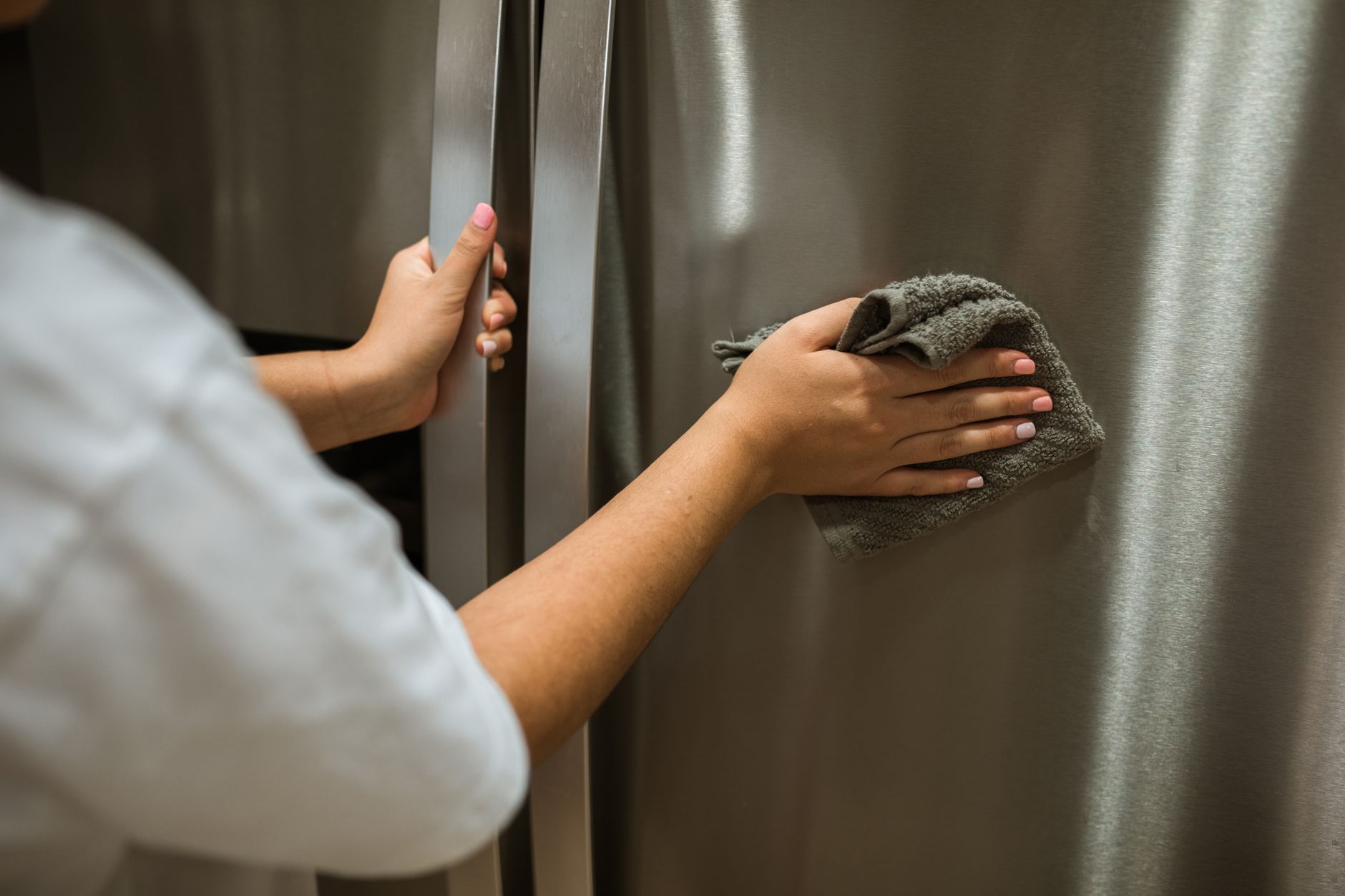
Fridge odor, and what that open box is really doing
Time to deal with the box of baking soda sitting on your top shelf with a date written on it in marker.
It is doing something. It is probably doing less than you think, and not by the mechanism on the packaging.
The chemistry is real: baking soda neutralizes both acids and bases, and fridge odors come from both directions — lactic acid from souring milk on one side, basic compounds from spoiling protein on the other. As Georgia Tech's School of Chemistry and Biochemistry explains in its piece on baking soda and fridge odors, it is not absorbing anything — the neutralization happens outside the box, in the air.
Which is exactly where the practical problem lies. Only the thin exposed surface at the top of the box is available to react, the air in a closed fridge barely circulates, and the amount of odor-causing compound that happens to drift into contact with that small surface is modest. When America's Test Kitchen tested an open box against sour milk, aged cheese, and spoiled fish, their tasters could not agree on whether it had done anything at all.
So: harmless, cheap, mildly useful, and nowhere near a substitute for finding the thing that smells and removing it. If your fridge has an odor, the odor has a source, and no passive box is going to out-argue a leaking package of something.
What actually works, in order: find and bin the source, wash the surface it was sitting on with hot soapy water, dry it, then wipe down with something fragrance-free that will not leave a scent of its own behind.
A scented cleaner in a sealed cold box full of butter, milk, and leftovers is a bad trade — dairy and fats pick up ambient smells readily, and you will taste your cleaning product for a week. Gentle Sen HOCl tablets dissolve in water to make a pH-balanced, fragrance-free, non-toxic solution that neutralizes odors rather than covering them, and breaks back down into salt water afterward. For the final wipe-down after the soap-and-water step, that is the useful property. It is not a degreaser and it is not doing the cleaning — the dish soap already did that.
Keeping it clean without doing this every week
- Wipe spills the day they happen. Said twice deliberately. Nothing else on this list comes close in value.
- Keep a thermometer in there. At or below 40°F, per FDA guidance. Freezer at 0°F.
- Raw meat on the bottom shelf, always. In a container or on a plate. Gravity is not interested in your organizational system.
- Line the crisper drawers. A sheet of paper towel in the bottom of each one catches the liquid that would otherwise pool under the produce, and takes two seconds to swap.
- Eat ready-to-eat foods promptly. The longer precooked and ready-to-eat items sit, the more time anything present has to multiply. That is the FDA's framing and it is the sensible one.
- Do a thirty-second shelf-front wipe weekly. Handle, shelf edges, drawer tops. The visible 10% that stops the job feeling enormous later.
Straight answers
What is the best natural cleaner for the inside of a fridge?
Hot water with a small amount of mild dish soap, then a rinse. It is unglamorous, but it is what FDA guidance describes for refrigerator interiors, and surfactants are genuinely the right tool for food residue and grease. For stuck-on messes, add a baking soda paste as a mild abrasive. For a fragrance-free final wipe, a pH-balanced HOCl solution works well because it leaves no scent for your food to absorb.
Can you clean a fridge with vinegar?
You can, but we would not. Acetic acid can break down the sealant on stainless steel and pit the finish over time, and repeated exposure can degrade the rubber door gasket — an expensive part your fridge's efficiency depends on. It also leaves a smell that dairy and fats will pick up. Hot soapy water does the same job without either problem.
Why shouldn't you mix baking soda and vinegar?
Because they neutralize each other. Baking soda is a base, vinegar is an acid, and combining them produces sodium acetate, carbon dioxide, and water. The impressive fizzing is the two cleaners destroying each other — what you are left with is essentially salt water. Use one or the other, never both in the same cloth.
Does a box of baking soda in the fridge actually work?
Partly, and not the way the box implies. It neutralizes rather than absorbs, and per Georgia Tech chemistry the reaction happens in the air outside the box — which means only the small exposed surface is doing anything, in a sealed space where air barely moves. America's Test Kitchen's testing was inconclusive. It is cheap and harmless, but it will never beat finding the thing that smells and removing it.
How often should you clean your refrigerator?
Three clocks. Spills get wiped the same day. A quick clean — pulling expired items and wiping shelf fronts — weekly. A full deep clean with everything out every three to four months. The same-day spill habit is the one that makes the deep clean a forty-minute job rather than an afternoon.
How do you clean a refrigerator door gasket?
A damp cloth with mild soap, working into the folds of the rubber by gently pulling the lip back with a finger. Then dry it thoroughly. Avoid vinegar, bleach, and anything abrasive — the gasket is rubber and it is structural, so damaging it costs you both seal quality and running efficiency.
Can bacteria really grow in a refrigerator?
Most bacteria slow down dramatically in the cold, which is the entire point of refrigeration. Listeria monocytogenes is the documented exception — FDA guidance states it grows at refrigerator temperatures, more slowly at or below 40°F, and it can persist on refrigerator surfaces for extended periods. That is why damp spots like crisper drawers and door gaskets matter more than surfaces that merely look dirty.
Should you unplug the fridge to clean it?
Not for a normal deep clean. Forty minutes with the door open will not meaningfully warm the contents, especially if perishables are in a cooler bag. Unplugging is worth it only for a full defrost on a manual-defrost model, or if you are pulling the appliance out to clean the condenser coils at the back — which is a separate job, worth doing annually, and the one place a vacuum beats a cloth.
The boring method is the right one
There is no clever trick here, and the popular ones are actively worse than doing nothing special. Hot water and dish soap, shelves out and washed in the sink, the gasket folds done by hand, everything dried before it goes back, and a thermometer in there so you actually know the temperature rather than assuming it. The reason to bother is not appearance — it is that a fridge is the one surface in your kitchen where cold does not fully settle the question, which makes the damp, hidden parts the ones worth your ten minutes.
And you can leave the baking soda box where it is. It is not hurting anything. It is just not the hero of this story — it is more of a character actor with a very good agent.
See how Gentle Sen works →- U.S. Food & Drug Administration — Ready-to-Eat Foods: Listeria growth at refrigerator temperatures, 40°F guidance, and refrigerator cleaning steps
- Georgia Tech School of Chemistry and Biochemistry — How baking soda actually affects fridge odor
- Bob Vila — Things you should never clean with vinegar, including stainless steel and rubber seals
Images from the Pexels photo library under the Pexels License. This post is for informational purposes only and is not medical or food-safety advice. Gentle Sen HOCl tablets are a multi-purpose cleaner and deodorizer. This product is not intended to diagnose, treat, cure, or prevent any disease. For cleanup following a specific food recall or contamination event, follow the current FDA or USDA instructions for that event.
0 comments