


A skincare routine for eczema-prone skin comes down to three things: a gentle fragrance-free cleanser, a barrier-repairing moisturizer applied immediately after washing, and a mineral SPF during the day. That's the routine. Everything else is either optional or actively making things worse.
A 2022 randomized controlled trial found that people following a simplified 3-step routine had fewer eczema flares and higher treatment adherence than those on multi-step regimens. The simpler routine won. Your twelve-product shelf is not helping. It may, in fact, be the problem.
Here's how to build a routine that actually works — what to use at each step, what to cut, and how to adjust it when things flare.
The short version
Morning: fragrance-free gentle cleanser → moisturizer (ceramides or petrolatum) → mineral SPF. Night: fragrance-free cleanser → moisturizer. That's it. No actives (retinoids, AHAs, BHAs) until the barrier is stable. No fragrance anywhere. Apply moisturizer to damp skin within 3 minutes of washing. On flare days, add a prescribed topical treatment before moisturizer — use it for the full directed course, not just until the redness fades.
In this guide
Why eczema-prone skin needs a different approach
Eczema-prone skin has a structurally weaker barrier — the outermost layer, the stratum corneum, loses moisture faster than it should and lets irritants through more easily. The standard skincare advice of "cleanse, tone, treat, serum, SPF" is designed for normal barrier function. Applying that routine to a compromised barrier strips it faster than it can repair.
The goal shifts. Instead of treating multiple skin concerns at once, you're doing one thing: rebuilding and protecting the barrier consistently. Every product in the routine has to earn its place. If it doesn't actively support the barrier or protect it from UV, it probably doesn't belong there — at least not until the skin is stable.
This matters especially for how to repair your skin barrier. The barrier doesn't recover overnight. It rebuilds over weeks of consistent, low-irritant input — the right cleanser, the right moisturizer, no disruption from actives. Rushing the process with exfoliants or brightening serums delays the repair it was meant to accelerate.
The cleansing step

The cleanser's job is to remove surface debris without stripping the barrier. That's it. It's not supposed to exfoliate, treat acne, brighten, or do anything else. A cleanser that does more than clean is usually doing more damage than good on eczema skin.
What to look for
- Fragrance-free — the single most important requirement
- Soap-free or syndet (synthetic detergent) — true soap disrupts the skin's natural slightly-acidic pH, which sits around 4.5–5.5. A syndet bar or liquid cleanser is formulated to match it
- Low-lather — heavy foam usually means sulfates, which are drying
- Minimal ingredient list — fewer ingredients, fewer potential irritants
How to cleanse
Lukewarm water only. Hot water feels soothing in the moment and strips the barrier in the minutes after. Keep face washing to once or twice daily — over-cleansing is a real problem. For the body, a short shower (five to ten minutes) in lukewarm water with cleanser on the affected areas only is enough.
Pat dry with a soft cotton towel. Never rub. Then move immediately to moisturizer — that's the next step and the more important one.
The moisturizing step
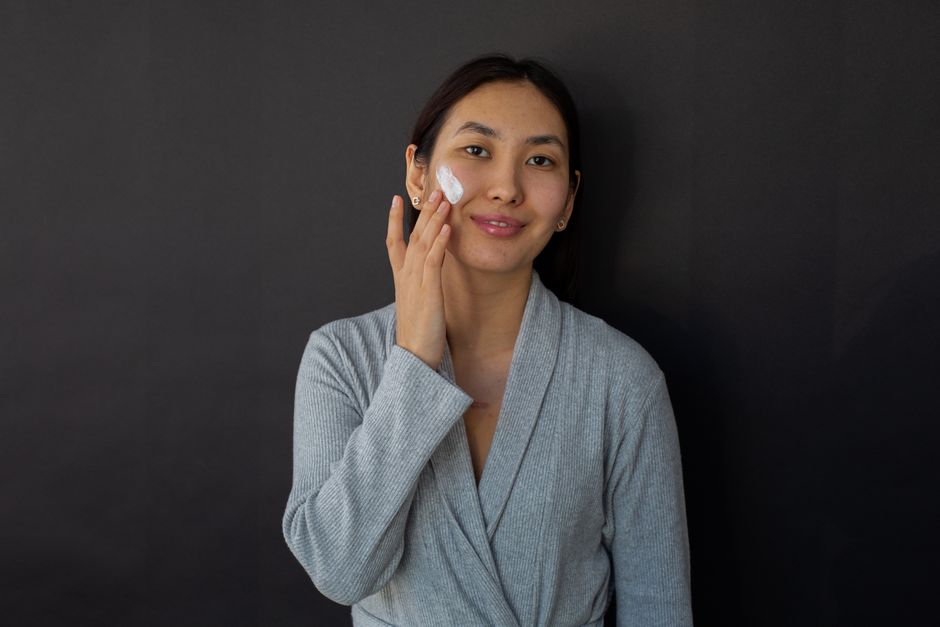
This is the most important step in the entire routine. The cleanse is preparation. The moisturizer is the work. Apply it within three minutes of patting dry, while the skin is still slightly damp — the moisture from washing is still there to be locked in, and it won't be for long.
Apply generously. Dermatologists consistently note that patients use far too little moisturizer. It should feel like a thorough application, not a light film.
Which format to use
Format matters more than brand. From most to least effective for eczema:
- Ointments (petrolatum, plain Vaseline) — highest oil content, best occlusion, most effective at preventing moisture loss. Greasy feel is the trade-off.
- Thick creams — ceramide-based creams are the practical sweet spot for most people. Less greasy than ointment, highly effective, well tolerated.
- Lotions — thinner, more water content, less effective for eczema. Fine for mild dryness, not for barrier repair.
What ingredients to look for
- Ceramides — lipids that make up about 50% of the skin barrier's structure. Directly replenish what eczema skin is deficient in.
- Petrolatum — occlusive, locks in moisture without absorbing. Safe for all ages including infants.
- Niacinamide — supports ceramide production and reduces redness. Well tolerated by most reactive skin.
- Colloidal oatmeal — has a long track record for calming itch and reducing inflammation in eczema skin.
- Glycerin / hyaluronic acid — humectants that draw water into the skin. Work best when applied to damp skin before an occlusive layer.
Related: Why is my skin so sensitive? Understanding the skin barrier and how to repair it
Ingredients to look for — and what to cut
Most eczema routines fail not because of what's missing but because of what's in them. The following ingredients are common in standard skincare products and reliably problematic for eczema-prone skin.
Look for
- Ceramides (1, 3, 6-II)
- Petrolatum
- Niacinamide
- Colloidal oatmeal
- Glycerin
- Shea butter (unscented)
- Hyaluronic acid
- Zinc oxide (in SPF)
Cut these
- Fragrance / parfum
- Ethanol / SD alcohol / denatured alcohol
- Retinoids (while barrier is compromised)
- AHAs and BHAs (glycolic, salicylic acid)
- Methylisothiazolinone (MI/MCI)
- Lanolin (common sensitizer)
- Urea at high concentrations
- Essential oils
Retinoids deserve a specific note. They're excellent for many skin concerns — anti-aging, acne, texture. Eczema is not one of them. Retinoids accelerate cell turnover and thin the outer layer, which is exactly the opposite of what a compromised barrier needs. This is one of those right-tool, wrong-job situations — like using a pressure washer to clean reading glasses. Hold off until the barrier is stable and you've discussed it with a dermatologist.
Your morning and night routine, written out

Morning routine
-
1
Rinse or gentle cleanse. If your skin wasn't particularly dirty overnight, a cool water rinse is enough in the morning. If you prefer to cleanse, use your fragrance-free cleanser and keep it brief.
-
2
Pat dry — then apply moisturizer within 3 minutes. Damp skin, not wet. The moisture from washing is still present and the moisturizer traps it in.
-
3
Apply mineral SPF. Every day, including overcast days. UV damage degrades the barrier over time and is one of the leading long-term contributors to skin sensitivity. Zinc oxide or titanium dioxide formulas tend to be better tolerated than chemical filters on reactive skin.
Night routine
-
1
Cleanse with your fragrance-free wash. Remove SPF, pollution, and the day's buildup. Keep it gentle and brief.
-
2
Apply moisturizer immediately while skin is damp. At night, you can use a thicker formulation — an ointment or richer cream — since there's no SPF to layer on top and you won't be touching anyone's furniture for a few hours.
-
3
Cotton gloves if scratching is a problem overnight. Loose cotton gloves worn after night moisturizer keep hands from scratching during sleep and help the moisturizer absorb. Sounds extreme. Works well.
Managing a flare day
The core routine stays the same during a flare. What changes is what goes in between cleansing and moisturizing.
If you have a prescribed topical corticosteroid or non-steroidal treatment: apply it to the affected areas before moisturizer, not after. The treatment needs direct skin contact to work. Moisturizer on top helps seal it in.
Use the full prescribed course. The most common mistake is stopping when the visible inflammation clears. The underlying barrier is still compromised when the redness fades. Stopping early nearly always leads to a faster rebound.
During a flare, remove every optional product from the routine. No new products, no experimenting. The barrier is already under stress. Adding variables makes it harder to identify what's helping and what isn't.
According to Healthline, maintaining the moisturizing routine even during flare-free periods is what reduces the frequency and severity of future flares — not just managing them when they appear.
Related: Eczema treatment: what actually helps and what to avoid
Straight answers (FAQ)
How many steps should an eczema skincare routine have?
Three, ideally. Cleanser, moisturizer, SPF (morning only). Research supports simpler routines for eczema — fewer products means fewer potential irritants and higher adherence. Add back steps only when the barrier is stable and you've confirmed a product is tolerated, testing one at a time with at least two weeks between additions.
Should I moisturize morning and night with eczema?
Yes, at minimum. Many dermatologists recommend moisturizing two to three times daily for eczema-prone skin — after every wash, and again mid-day if the skin feels tight. The morning application locks in moisture for the day. The night application, which can be thicker, does the bulk of barrier repair while you sleep.
What is the best moisturizer for eczema-prone skin?
Thick, fragrance-free creams or ointments containing ceramides, petrolatum, or both. Plain petrolatum (Vaseline) is among the most effective and least irritating options available and costs almost nothing. CeraVe Moisturizing Cream, Eucerin Original Healing Cream, and Vanicream are frequently recommended by dermatologists. The format matters more than the brand — ointment beats cream, cream beats lotion for eczema.
Can I use retinol if I have eczema?
Not while your barrier is compromised. Retinoids accelerate skin cell turnover and thin the outer layer — which is the opposite of what eczema skin needs. Once the barrier is stable and flares are infrequent, you can discuss low-concentration retinol options with a dermatologist. Start on non-affected areas and patch test carefully.
How do I know if a product is safe for eczema-prone skin?
Check the ingredient list: no fragrance, no alcohol (ethanol/SD alcohol/denatured alcohol), no preservatives like methylisothiazolinone, no essential oils. Then patch test — apply a small amount to the inside of your wrist or elbow crease for 48 hours before using it on your face or a large area. If there's no reaction, introduce it gradually, one product at a time.
How do I reduce skin inflammation quickly?
For immediate relief, a prescribed low-potency topical corticosteroid is the most effective short-term tool. At home without a prescription: cool compresses for five to ten minutes can reduce immediate itch and redness. Removing the trigger — the product, the fabric, the heat — is the fastest route to reducing inflammation that keeps recurring. Moisturizing well consistently reduces baseline inflammation over time.
Is it okay to exfoliate eczema-prone skin?
Not during a flare, and not frequently when the skin is stable. If you want to exfoliate, wait until the skin is well-controlled, choose a very low concentration chemical exfoliant (lactic acid is typically the most gentle option), patch test thoroughly, and use it once every one to two weeks at most. Physical scrubs — walnut shells, sugar, brushes — should be avoided entirely on reactive skin.
How do I repair my skin barrier?
Consistent application of ceramide-rich moisturizer to damp skin twice daily is the core repair strategy. Avoid products that strip lipids from the skin surface — fragrance, alcohol, harsh cleansers, over-exfoliation. Keep the environment stable: fragrance-free laundry products, a humidifier in dry seasons, loose cotton clothing. Barrier repair takes weeks of consistent low-irritant input, not days. There is no shortcut that works.
The takeaway
The most effective skincare routine for eczema-prone skin is the simplest one you'll actually stick to. Gentle cleanser, barrier-repairing moisturizer applied immediately after washing, mineral SPF in the morning. No actives until the skin is stable. Fragrance-free everything.
We think about this a lot at Gentle Sen — not just which skincare products to use, but what else in the environment is touching your skin. Laundry residue, surface cleaners, everything your skin contacts between washes. Our HOCl tablets are designed for exactly this: a fragrance-free, non-toxic cleaning option for the surfaces and fabrics that eczema skin lives against.
If the routine above isn't bringing your skin under control after 4–6 weeks, see a dermatologist. There are prescription options — non-steroidal topicals, biologics for moderate-to-severe cases — that aren't available over the counter and make a real difference for people whose eczema doesn't respond to home management alone.
- Healthline — How to Build an Eczema Skin Care Routine
- Cleveland Clinic Health Essentials — Skin Care Products and Routines for Eczema
- Harvard Health Publishing — Take Control of Eczema with Simple Skin Care Strategies
This article is for informational purposes only and does not constitute medical advice. Gentle Sen products are multi-purpose cleaners, not medical treatments. Consult a qualified dermatologist or healthcare provider for diagnosis and treatment of eczema.
0 comments